What Is IIoT?
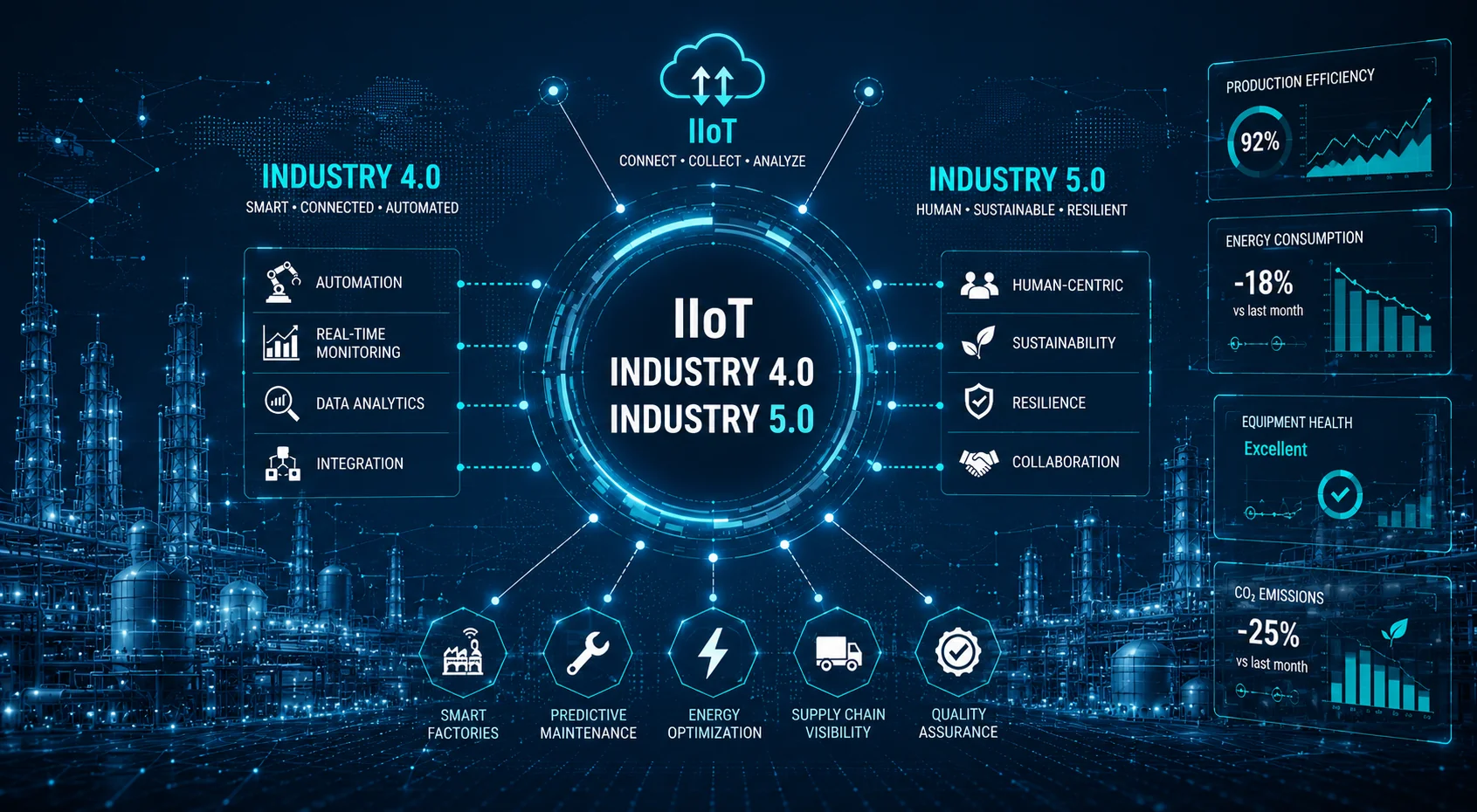
IIoT stands for the Industrial Internet of Things. In simple terms, it means connecting industrial equipment — motors, compressors, pumps, panels, meters, production machines — to a network so their condition and performance can be measured continuously and viewed in one place.
A traditional facility relies on manual readings, periodic inspections, and operator experience. An IIoT-enabled facility supplements this with sensors and meters that report data automatically: energy consumption per line, vibration on a critical motor, pressure in a compressed air system, temperature in a process loop.
The hardware itself is not new. Sensors, meters, and PLCs have existed for decades. What IIoT changes is connectivity and accessibility: data that used to stay inside a control panel or a paper logbook now reaches a dashboard that engineers and managers can actually use.
What Industry 4.0 Means in Practical Terms
Industry 4.0 is the broader framework around IIoT. It describes a facility where machines, data systems, and people are connected, and where decisions are increasingly informed by real measured data rather than assumption.
Stripped of the marketing language, Industry 4.0 in a real facility usually means a combination of:
- Connected equipment that reports its own status and performance.
- Centralized data instead of isolated readings spread across departments.
- Automation and controls that respond to conditions rather than fixed schedules.
- Analysis that turns raw measurements into operational insight — where energy is being lost, which machine is drifting out of normal behavior, which line is underperforming.
For most facilities in Iraq and the region, Industry 4.0 does not mean replacing equipment or building a fully automated plant. It means adding measurement, connectivity, and structured data to the equipment that already exists, so the facility can be managed with facts instead of estimates.
What Industry 5.0 Adds Beyond Industry 4.0
Industry 5.0 is a newer concept, and it is best understood as a correction of emphasis rather than a new generation of technology. Where Industry 4.0 focused heavily on automation and data, Industry 5.0 puts people back at the center of the conversation.
In practical terms, Industry 5.0 emphasizes three things:
- Human–machine collaboration. Technology should support operators, technicians, and engineers — giving them better information and reducing repetitive work — rather than attempting to remove them from the process.
- Resilience. Facilities should be able to absorb disruption: power instability, supply chain interruptions, equipment failures. Monitoring and flexible controls contribute directly to this.
- Sustainability. Energy efficiency and reduced waste are treated as core operational goals, not side benefits.
For facilities in this region, the resilience and sustainability themes are particularly relevant. Grid instability, generator dependence, and high energy costs make visibility and efficiency a matter of operational survival, not just optimization.
Why Visibility Is the First Step
There is a simple principle that underlies all of this: a facility cannot improve what it does not measure.
Many plants operate without knowing their real energy cost per unit of production, the actual loading of their motors and compressors, or the true condition of critical equipment between failures. Decisions are made from monthly bills, occasional readings, and memory. When losses are invisible, they persist — and when a failure develops slowly inside a machine, it surfaces only as an unplanned shutdown.
Visibility changes this. Once consumption, condition, and performance are measured continuously, patterns appear: a compressor that runs loaded at night when no one is producing, a motor drawing more current than its twins, a line whose output per kilowatt-hour has quietly declined. None of these problems can be solved before they can be seen.
This is why a sound IIoT program starts with measurement and baselines — often beginning with a structured energy and performance audit — before any discussion of advanced automation.
Practical IIoT Applications in Facilities
The most useful IIoT applications are usually the least glamorous ones. In real facilities, the highest-value use cases tend to be:
- Energy monitoring. Sub-metering by line, department, or major load, so energy cost can be tied to actual production and abnormal consumption can be caught early.
- Machine condition monitoring. Tracking vibration, temperature, and current on critical rotating equipment to detect developing faults before they become failures.
- Compressor monitoring. Compressed air is one of the most expensive utilities in many plants. Monitoring load cycles, pressure, and run hours exposes leaks, poor control settings, and oversized or short-cycling machines.
- Pump and motor monitoring. Identifying motors running far from their efficient operating point, pumps throttled against valves, and equipment running when it does not need to.
- HVAC monitoring. Tracking temperatures, run schedules, and consumption in commercial buildings and conditioned industrial spaces, where HVAC is often a dominant load.
- Production line visibility. Simple counts, run states, and stoppage tracking that show where output is actually being lost during a shift.
- Maintenance alerts. Automatic notifications when a parameter leaves its normal range, so maintenance teams respond to evidence instead of waiting for breakdowns.
- Remote dashboards. A single view of the facility's key indicators, accessible to managers and engineers without walking the plant or waiting for reports.
- Power quality monitoring. Recording voltage events, harmonics, imbalance, and power factor — particularly important where grid supply is unstable and facilities switch between grid and generator power.
A facility does not need all of these at once. It needs the two or three that address its largest losses and risks first.
Common Mistakes When Implementing IIoT
Many IIoT initiatives underdeliver, and the reasons are usually organizational rather than technical. The most common mistakes:
- Buying sensors without a clear objective. Hardware is purchased before anyone defines what question the data should answer. The result is instrumentation without purpose.
- Collecting data no one uses. Dashboards are installed, data accumulates, and after a few months nobody opens them — because the data was never connected to decisions, responsibilities, or routines.
- Ignoring maintenance teams. The people who will act on the data are left out of the design. If technicians do not trust or understand the system, alerts are ignored and value is lost.
- Poor integration with existing systems. New monitoring runs in isolation from existing PLCs, SCADA, or maintenance records, creating parallel systems instead of one coherent picture.
- No baseline or KPI structure. Without an initial baseline and agreed performance indicators, there is no way to know whether anything improved.
- Overcomplicating the first phase. Projects begin with plant-wide ambitions, stall in complexity, and lose management support before delivering a single result. A focused first phase on one or two critical systems almost always performs better.
The pattern across all of these is the same: technology was treated as the goal, when the goal should have been a specific operational improvement.
How MesoAxis Approaches IIoT and Smart Manufacturing
MesoAxis approaches IIoT as one part of a connected engineering system, not a standalone product.
In practice, this means digital monitoring is built on top of a real understanding of the facility. An energy and performance assessment establishes where losses occur and what is worth measuring. Industrial optimization work defines the operational improvements the data should support. Maintenance planning and CMMS readiness ensure that condition data and alerts feed into a maintenance structure that can actually act on them. Automation, controls, and IIoT engineering then connect the equipment, instrumentation, and dashboards into a system that fits the plant as it actually operates — including integration with existing panels, PLCs, and metering rather than working around them.
The sequence matters. Measurement before automation, objectives before hardware, and people before platforms. This is how IIoT produces operational results rather than unused dashboards.
Who Benefits from IIoT?
Connected monitoring and practical automation are relevant across a wide range of facilities, including:
- Manufacturing plants, where energy, machine condition, and line performance directly determine cost per unit
- Cement, concrete, and block plants, with heavy motor loads, harsh operating conditions, and high energy intensity
- Steel and metalworking facilities, where large electrical loads and power quality issues carry significant cost
- Food and beverage facilities, where refrigeration, compressed air, and process stability are critical to both cost and product quality
- Commercial buildings, where HVAC, lighting, and power systems are the main operating costs
- Oil and gas support facilities, where equipment reliability and utility performance affect continuous operations
- Power generation facilities, where monitoring supports availability, efficiency, and maintenance planning
More detail on how these sectors are served is available on our industries page.
A Practical Path Forward
IIoT, Industry 4.0, and Industry 5.0 are not destinations a facility arrives at by purchasing technology. They are a direction: toward facilities that are measured, visible, maintainable, and managed on evidence. The facilities that benefit most are the ones that start with a clear objective, a realistic first phase, and an honest baseline.
If you are considering digital monitoring, automation, or a structured assessment of where your facility stands today, contact MesoAxis to discuss a practical starting point.